
 Linda Rae Sande continues her Grand Tour of the Aristocracy with facts about Rome.

If you’ve ever been to the Eternal City, you’ve probably had a chance to climb the Spanish Steps or stare up at the oculus in the ceiling of the Pantheon. Maybe you’ve dunked your hand into one of the hundreds of fountains spouting water from aqueducts that originated over two thousand years ago. Or perhaps you wondered at the Egyptian obelisks or other towers found in the center of piazzas.
Although all of these features existed in 1841, some were quite different from what we find in Rome today.

The Forum, 1846
For example, prior to the time of this story. archaeological excavations hadn’t been done in the area of the Roman Forum. Covered in dirt and debris, the area was known as Campo Vaccino—literally a cow pasture, where cattle roamed among a debris field of marble blocks and pieces of columns. The practice of reusing marble and stone blocks taken from older temples was a common practice, a form of recycling we can only lament these days, and the Forum as we see it today is evidence of it—entire temples are missing, their foundations barely evident.
Other Roman temples, such as the Pantheon, have been converted to Catholic churches, which may have saved them from a similar fate. The statuary of Roman gods and goddesses that once decorated the niches lining the interior of the Pantheon have since been replaced with those of Christian mythology, but the coffered ceiling and oculus remain the same as when they were built. The Pantheon’s roof can thank self-healing Roman concrete for its endurance.

Abraham-Louis-Rodolphe Ducros Colosseum before 1810
The majestic Colosseum has been undergoing restoration for decades, but back in 1841, the arena was overgrown with vines and bushes—some extending up several stories and so thick, some passages at the top of each tier of seating were blocked. All of its marble veneer, which once encased the arena so it glowed in the daylight, has long since disappeared. As you can see in the accompanying artwork from the early 1800s, the condition of the Colosseum was much worse then it is now!

Pannini, Giovanni Paolo – Fountain of Trevi, Rome – 18th century
What hasn’t changed? The Spanish Steps, which were built in 1725 as a means of connecting the neighborhood featuring the Chiesa della Santissima Trinità dei Monti with the Piazza di Spagna and its Fontana della Barcaccia. The fountain featuring a sinking boat was built in honor of a boat that was found shipwrecked in the very same spot when the Tiber flooded in 1598. By the time of our story, many of the 135 steps were in need of repair, and their restoration has been completed several times.
Another survivor? Trevi Fountain. Although the area in front of the largest fountain in Rome has undergone numerous changes over the centuries, the fountain itself remains largely unchanged. Toss a coin over your left shoulder when you visit so you can be assured you’ll be visiting Rome again in the future.
About the Book
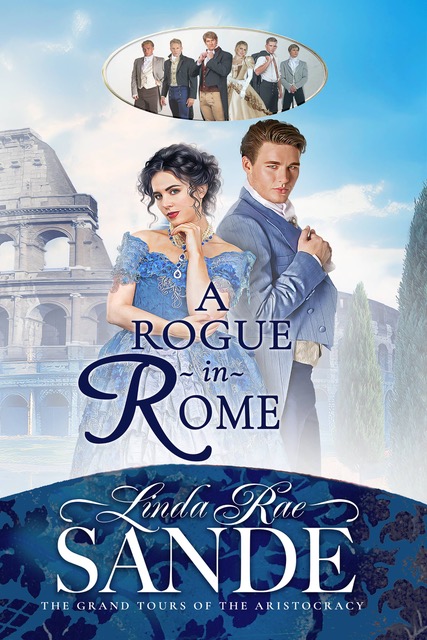 In my latest early Victorian romance release, A ROGUE IN ROME, the city of Rome plays an important part as the backdrop for not just one, but two romances. As part of his Grand Tour, our young hero, David, Viscount Penton, tours the attractions of Rome with his family members and their hosts, including our heroine, Lady Vittoria. Theirs is a contemptuous relationship, borne of an unfortunate incident that occurs during her come-out ball. She’s convinced David is a rake, when in fact he’s an amiable heir who was simply trying to save her from a true rogue.
Our other romance features older characters. Patrick is an American widower from Boston. He’s in search of sources for wool and silk when he discovers Vittoria’s great aunt Armenia at the ball. A spinster, Armenia has had her fill of unscrupulous men, so it takes more than a tour of four fountains to convince her she is loved.
You can find A ROGUE IN ROME at all the major retailers and in the anthology, HIS TO ADORE.
https://books2read.com/a-rogue-in-rome and https://books2read.com/histoador
.
About the author
 A self-described nerd and student of history, Linda Rae spent many years as a technical writer specializing in 3D graphics workstations, software and 3D animation (her movie credits include SHREK and SHREK 2). Getting lost in the rabbit holes of research has resulted in historical romances set in the Regency and Victorian eras as well as in Ancient Greece.
A fan of action-adventure movies, she can frequently be found at the local cinema. Although she no longer has any fish, she follows the San Jose Sharks. She is a member of Novelists, Inc. (NINC) and Wyoming Writers, Inc. and makes her home in Cody, Wyoming.
